Image 1 of 4
The Electronic Devices and Circuits (EDC) Laboratory at the National Institute of Technology Patna (Patna Campus) is a foundational laboratory that supports undergraduate teaching in the Department of Electronics and Communication Engineering. It primarily caters to the students of the Electronics and Communication Engineering (ECE) and Electrical Engineering (EE) programs through laboratory courses such as Elements of Electronics Engineering, Semiconductor Devices, and Electronics Workshop. The laboratory is designed to bridge the gap between theoretical concepts and practical implementation by providing hands-on training in semiconductor devices, analog electronic circuits, electronic measurements, and hardware design. Equipped with modern instruments and experimental setups, the laboratory enables students to develop fundamental skills in circuit analysis, electronic testing, troubleshooting, and prototyping, thereby establishing a strong foundation for advanced studies in electronics and related disciplines.
The Digital Electronics and Microprocessor & Microcontroller Laboratory provides students with hands-on training in digital system design, embedded systems, and hardware implementation. The laboratory supports undergraduate courses by bridging theoretical concepts with practical applications through experiments in digital logic design, microprocessor programming, and microcontroller-based system development. Students gain practical experience in the design and analysis of combinational and sequential logic circuits, timing circuits, ADC/DAC interfacing, and digital circuit simulation using industry-standard software tools. The laboratory also offers comprehensive training in programming and interfacing with 8085/8086 microprocessors, 8051 microcontrollers, ARM-based controllers, and peripheral devices such as LCDs, keyboards, stepper motors, timers, counters, and communication interfaces. Equipped with modern embedded system development platforms including Arduino Leonardo, Raspberry Pi 5, ARM Cortex-M3, NVIDIA Jetson Nano, and the PYNQ FPGA Development Kit, the laboratory enables students to work on Internet of Things (IoT), embedded Linux, FPGA-based system design, Artificial Intelligence (AI), robotics, and intelligent edge computing. The laboratory fosters innovation through project-based learning and research, preparing students with the practical skills required for careers and advanced studies in digital electronics, embedded systems, computer architecture, VLSI, and smart technologies.
The Digital Signal Processing Laboratory provides students with hands-on experience in the analysis, processing, and implementation of digital signal processing (DSP) techniques. The laboratory supports undergraduate, postgraduate, and research activities by bridging theoretical concepts with practical applications through software simulation and real-time hardware implementation. The laboratory enables students to analyze discrete-time signals and systems, perform spectral analysis using Fourier and Z-transforms, and design and implement FIR and IIR digital filters. Students gain practical experience in real-time signal processing using DSP development platforms, MATLAB, Code Composer Studio (CCS), and Python. Equipped with high-performance computing systems, Digital Storage Oscilloscopes (DSOs), Texas Instruments TMS320C6xxx DSP development boards, programmable logic devices (PLDs), CCD cameras, biometric sensors, function generators, and industry-standard software tools, the laboratory facilitates experimentation in digital signal processing, embedded system design, and real-time algorithm development. The laboratory also supports project-based learning and research in telecommunications, biomedical signal processing, audio and speech processing, image and video processing, wireless communication, and intelligent signal analysis, preparing students for advanced studies and careers in signal processing and related technologies.
The VLSI Design Laboratory provides students with hands-on training in integrated circuit (IC) design, semiconductor device modeling, and electronic design automation (EDA). The laboratory supports undergraduate, postgraduate, and research activities by bridging the gap between theoretical concepts and practical implementation of analog, digital, and mixed-signal integrated circuits. The laboratory enables students to gain practical experience in CMOS circuit design, logic synthesis, transistor-level simulation, layout design, physical verification, FPGA-based prototyping, and semiconductor device simulation. Students are trained using industry-standard EDA tools for the complete VLSI design flow, from circuit design and verification to implementation and performance analysis. Equipped with advanced software platforms including Cadence Design Systems, Synopsys, Xilinx (AMD), and Silvaco TCAD, the laboratory facilitates education and research in analog and digital IC design, FPGA-based system development, System-on-Chip (SoC) design, semiconductor device modeling, and VLSI verification. The laboratory promotes project-based learning and research, preparing students for careers and advanced studies in microelectronics, semiconductor technology, and VLSI system design.
The VLSI Fabrication Laboratory provides students and researchers with hands-on experience in semiconductor device fabrication, microfabrication processes, and integrated circuit (IC) manufacturing. The laboratory supports undergraduate, postgraduate, and research activities by bridging theoretical concepts with practical semiconductor processing and device characterization. The laboratory enables students to gain practical experience in wafer preparation, photolithography, thin-film deposition, oxidation, chemical etching, ion implantation, metallization, and semiconductor process integration. It also provides training in the characterization and testing of fabricated devices using advanced electrical and material analysis techniques. Equipped with state-of-the-art microfabrication and characterization facilities, the laboratory supports research in semiconductor process technology, MEMS, nanoelectronics, advanced materials, and VLSI fabrication. The laboratory also facilitates device characterization through structural, material, and electrical analysis using modern metrology and semiconductor testing equipment. By promoting project-based learning and interdisciplinary research, the laboratory prepares students for careers and advanced studies in semiconductor manufacturing, microelectronics, nanotechnology, and integrated circuit fabrication.
The Microwave Engineering Laboratory is designed to provide students with practical exposure to the generation, transmission, measurement, and analysis of microwave signals and components. The laboratory supports hands-on learning in microwave engineering by enabling students to perform experiments related to waveguides, microwave junctions, directional couplers, active microwave devices, and network analysis. The students begin by familiarizing themselves with the Microwave Test Bench and frequency measurement techniques using a frequency meter. The laboratory then introduces the measurement of important waveguide parameters and the performance evaluation of microwave components such as multi-hole directional couplers, E-Plane Tee, H-Plane Tee, and Magic Tee. The laboratory also includes the study of Reflex Klystron characteristics, where students observe the variation of output power and operating frequency with repeller potential. Experiments on the Gunn Diode help students understand the I-V characteristics of microwave semiconductor devices. Further, the laboratory provides training in S-parameter measurement of microwave filters and antennas using a Network Analyser. Modern computational tools and electromagnetic simulators are also used to study TE and TM modes in rectangular waveguides, allowing students to correlate theoretical concepts with simulated field distributions. Overall, the Microwave Engineering Laboratory equips students with practical knowledge of microwave devices, wave propagation, component characterization, and measurement techniques, thereby strengthening their understanding of microwave communication systems and high-frequency engineering applications.
The Advanced Communication Lab provides students and researchers with hands-on training in modern communication technologies, including wireless communication, microwave engineering, optical fiber communication, and antenna systems. The laboratory supports undergraduate, postgraduate, and research activities by bridging theoretical concepts with practical experimentation, measurement, and system design. Students gain practical experience in RF and microwave measurements, antenna characterization, optical communication systems, fiber optic components, communication signal generation and analysis, and PCB prototyping. The laboratory also facilitates project-based learning and research in wireless communication, microwave circuits, antenna design, RF systems, and optical fiber communication, preparing students for advanced studies and careers in communication engineering.
The Internet of Things (IoT) Laboratory is designed to provide students with practical knowledge of IoT technologies by integrating hardware, software, networking, and cloud computing concepts. The lab begins with familiarization with Arduino and Raspberry Pi platforms, including software installation, operating system setup, and hardware configuration. Students learn to connect Raspberry Pi with a laptop and understand GPIO programming for controlling external devices. The experiments focus on interfacing various sensors and actuators such as LEDs, IR sensors, PIR sensors, temperature sensors, humidity sensors, smoke sensors, relays, motors, LCDs, and servos. Students develop programs to monitor sensor inputs, control outputs, perform PWM-based motor speed control, and implement real-time automation applications. The laboratory also introduces wireless communication by configuring Wi-Fi modules and connecting embedded devices to cloud platforms. Students gain hands-on experience with IoT protocols, particularly MQTT, for publishing and retrieving sensor data from cloud services. The final experiments involve implementing real-world IoT applications such as smart lighting, environmental monitoring, water quality monitoring, and smart agriculture systems. Overall, the IoT Laboratory equips students with the skills required to design, develop, and deploy intelligent connected systems by combining embedded programming, sensor interfacing, networking, cloud computing, and automation technologies.
A Communication Engineering Laboratory is a specialized laboratory where students gain practical experience with the principles, techniques, and equipment used in analog and digital communication systems. It bridges the gap between theoretical concepts taught in the classroom and their real-world implementation through hands-on experiments. The laboratory enables students to study the generation, transmission, reception, and processing of electrical and electromagnetic signals. Using trainer kits, measuring instruments, and software-defined radio platforms, students perform experiments on modulation and demodulation techniques, multiplexing, signal sampling, analog-to-digital and digital-to-analog conversion, pulse modulation, and digital communication schemes. They also learn to analyze signals using oscilloscope, function generator, and digital Multimeter.
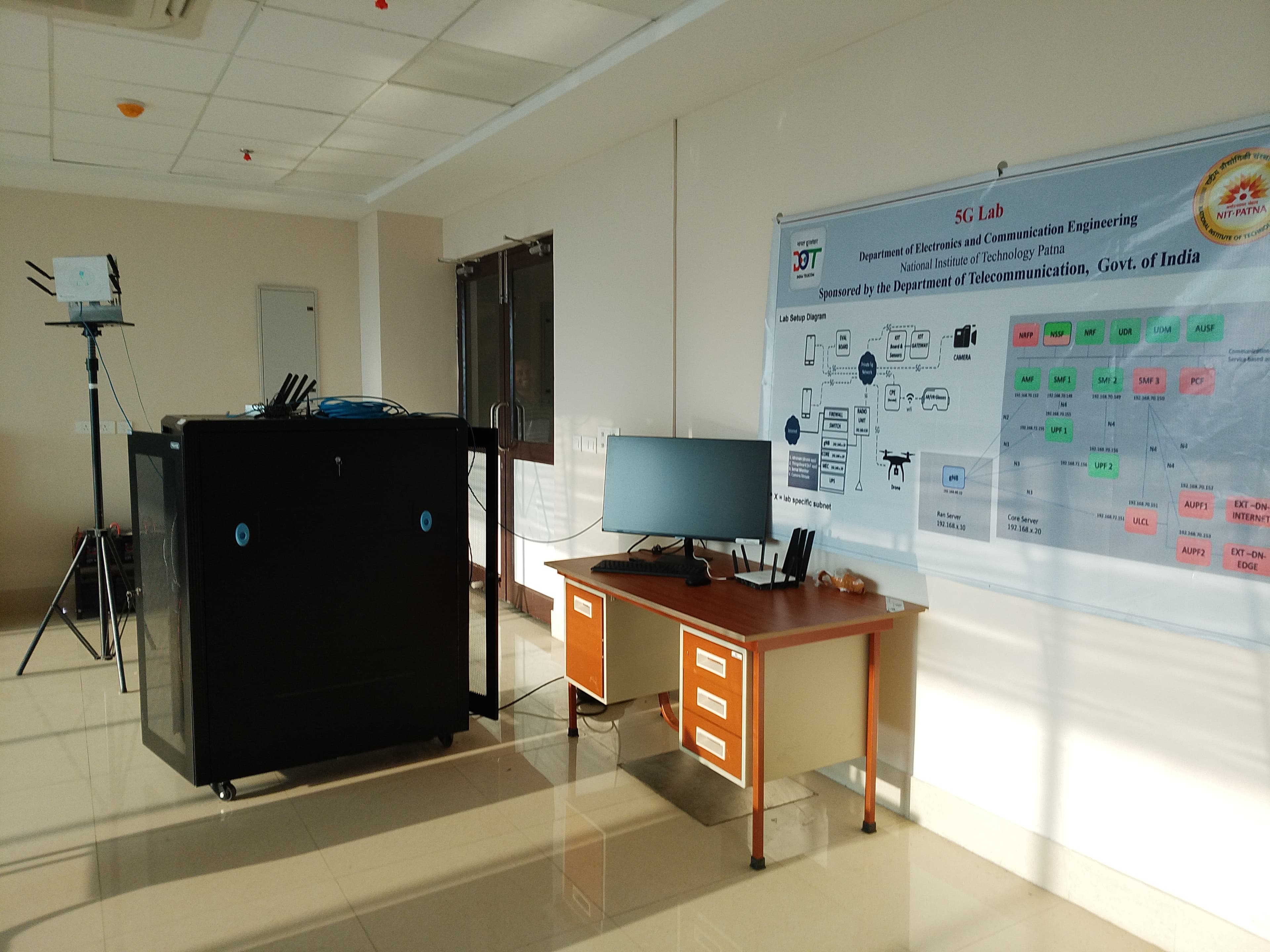
The 5G Laboratory is an advanced research, innovation, and skill development facility that provides a complete end-to-end 5G Standalone (SA) network environment. The laboratory enables students, researchers, faculty members, startups, and industry professionals to design, deploy, test, and optimize next-generation wireless communication systems. It integrates 5G Core, Radio Access Network (gNodeB), Multi-access Edge Computing (MEC), AI/ML, IoT devices, network virtualization, cybersecurity, and application development platforms to facilitate real-time experimentation and prototype development. The lab serves as a platform for developing indigenous 5G technologies and use case, validating new communication protocols, building intelligent IoT applications, and supporting interdisciplinary research aligned with Industry 4.0 and Digital India initiatives.