

Image 1 of 3
The Electronics Workshop Laboratory provides practical exposure to the fundamentals of electronics, circuit design, testing, measurement, and troubleshooting. Students develop hands-on skills by assembling analog and digital circuits using modern test instruments. It supports experiments in semiconductor devices, operational amplifiers, and digital logic. The lab is equipped with advanced tools including digital oscilloscopes, arbitrary waveform generators, multi-output DC power supplies, soldering stations, and PCB prototyping tools, fostering practical learning and innovation.
The Digital Electronics Laboratory provides practical knowledge of digital logic design, combinational and sequential circuits, and embedded hardware interfacing. Students verify fundamental concepts such as Boolean algebra, logic gates, multiplexers, flip-flops, and counters through hands-on experiments. The lab is well-equipped with digital trainer kits, programmable logic development platforms, logic analyzers, and FPGA/microcontroller boards, offering an excellent environment for designing, testing, and debugging modern digital systems.
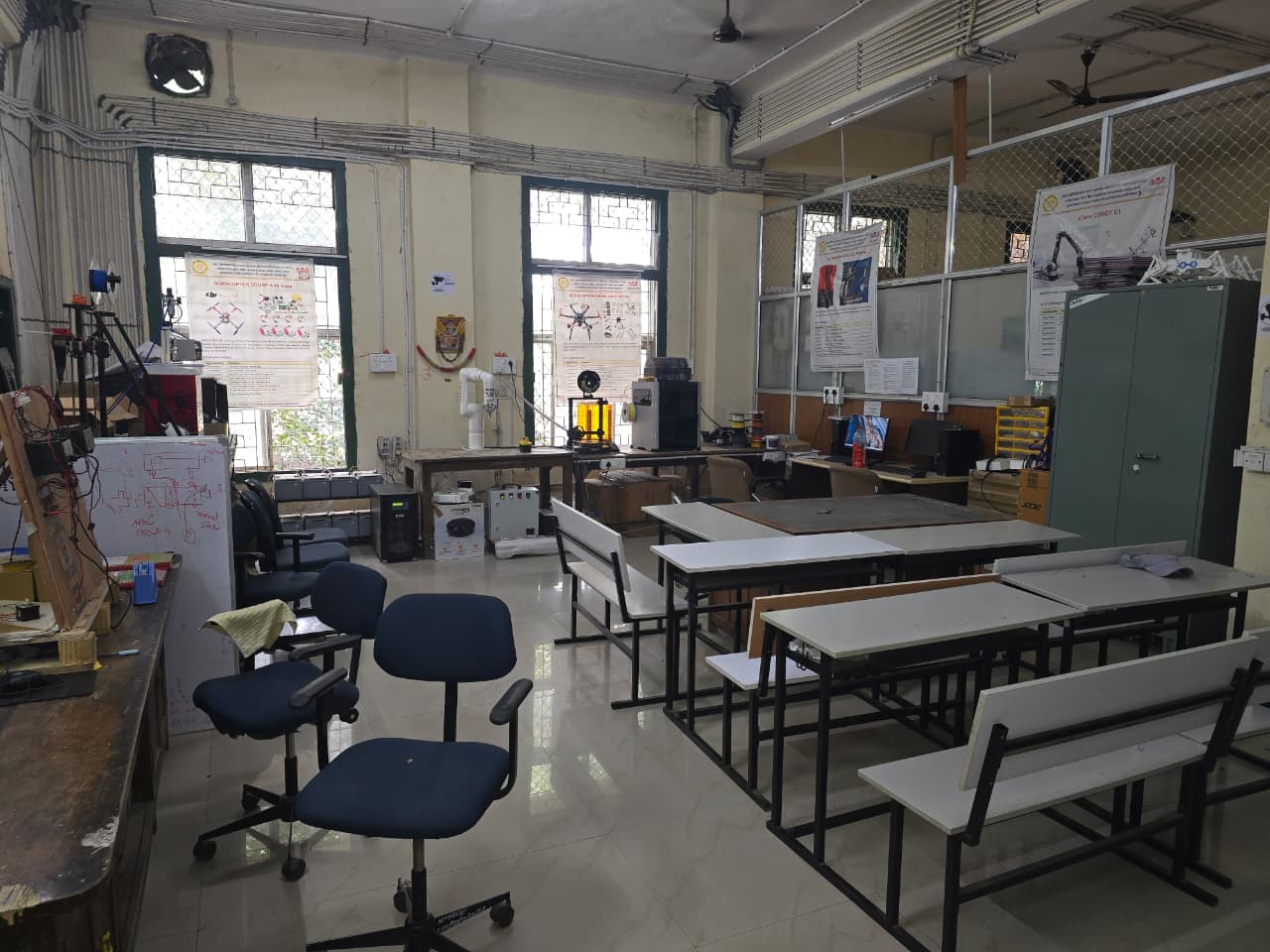
This laboratory provides interdisciplinary hands-on training in mechatronics, robotics, additive manufacturing, and autonomous systems. It integrates mechanical systems, electronics, control engineering, AI, and digital manufacturing. Students gain practical experience in robotic manipulation, rapid prototyping, 3D printing, and smart automation. Advanced facilities include the xTerra Cobot C1, ADDVERB Industrial Robotic Arm, resin/FDM 3D printers, a laser cutting machine, and quadcopter drones, making it an excellent platform for Industry 4.0 applications.
This laboratory provides a comprehensive understanding of the modeling, analysis, simulation, and design of mechatronic systems using computational tools. It emphasizes the integration of mechanical, electrical, control, and computer engineering principles. Students develop mathematical models, simulate dynamic behaviors, and validate control strategies using the SciLab XCOS environment. Key learning areas include transfer function analysis, sensor/actuator modeling, DC motor modeling, and PID controller design.
The Actuators, Drives, and PLC Laboratory imparts practical knowledge of industrial automation, programmable logic controllers, electro-pneumatic systems, and motor drives. Students gain hands-on experience in ladder logic programming, relay logic, HMI-based monitoring, and sequential control. The lab is equipped with FATEK PLCs, HMI training kits, pneumatic solenoid valves, and industrial sensors, developing crucial skills for Industry 4.0 and advanced manufacturing.
This laboratory provides practical knowledge of pneumatic and hydraulic systems used in modern industrial automation. Students gain hands-on experience designing, assembling, and troubleshooting pneumatic circuits using industry-standard components. Equipped with the Janatics Pneumatic Trainer Kit, the lab features pneumatic cylinders, directional and flow control valves, and electro-pneumatic modules. It enables experiments in sequential control, actuator force regulation, PLC interfacing, and factory automation.
This laboratory offers comprehensive practical knowledge of sensing technologies, measurement systems, signal conditioning, and sensor interfacing for modern automation. Students learn the operating principles and calibration of industrial sensors for temperature, displacement, and pressure. Equipped with trainer kits for Thermocouples, RTDs, LVDTs, and load cells, along with a 37-in-1 sensor kit and embedded platforms, the lab prepares students for real-world applications in robotics, IoT, and intelligent manufacturing.
This laboratory provides practical knowledge of microprocessor and microcontroller architecture, programming, interfacing, and embedded system development. Students explore fundamental concepts such as instruction execution, memory organization, interrupt handling, and real-time control. Equipped with 8086 and 8051 trainer kits, as well as digital I/O interfacing modules, the lab supports hands-on experiments in assembly language programming and hardware design for advanced automation and IoT systems.
The Control Systems Laboratory imparts practical knowledge of the analysis, modeling, simulation, and design of linear and nonlinear control systems. Students perform experiments on closed-loop systems, time response analysis, and PID controller design while investigating stability using Root Locus and Bode plots. Utilizing SciLab/XCOS for modeling, alongside Arduino/ESP32 boards and the NVIDIA Jetson AGX Orin Developer Kit with LiDAR, the lab provides a strong foundation for intelligent robotics and autonomous systems.